
Risks to Consider When Purchasing Technology-Based IP for Securitization
Contact Michael Sarlitto and Dan Roman | Visit Website | About The Author
This article focuses on risks associated with technology-based intellectual property (“IP”). We provide transaction evaluators and originators with a working list of risk-influenced items to consider when reviewing opportunities involving the purchase of IP for securitization, specifically in cases where the source of the asset’s value is derived from commercialization, re-commercialization, and assertion. It is intended to assist practitioners identify and assess these risks, make better-informed investment decisions, and achieve their transaction goals.
Risk can be anything that threatens or limits the ability of a transaction to achieve its intended goals or objectives. Risk management, therefore, is the process of logically and systematically contemplating all possible undesirable outcomes before they occur, quantifying and pricing their effects, and establishing procedures to recognize, avoid, minimize, and/or cope with these or other outcomes and their eventual impacts. Three fundamental activities are associated with transactional risk management efforts: assessment, pricing, and control.
- Risk assessment is the process of identifying modes of failure and their probability of occurrence.
- Risk pricing builds upon this output to model the range of outcomes, their interactions, and potential economic impact so as to ensure that the transaction is valued correctly and that risk is offset through deal structuring or other means.
- Risk control employs the first two activities to develop a combination of techniques and strategies designed to monitor, manage, and mitigate risks over time.
In general, large-scale transactions (as measured by value) tend to require more detailed risk planning due to the number and complexity of risks typically involved and the financial impact of undesirable outcomes. As a result, larger transactions will also include the development and analysis of alternative strategies and evaluation criteria. The ranking of risks and development of mitigation strategies in larger transactions often will demand greater sophistication in quantifying and qualifying the probability of occurrence and/or evaluation of impact. This article is not intended to provide an exhaustive list of risks and assessment criteria that a transaction team may observe. If exhaustive lists were possible, the modes of failure in transactions would be finite.
A RISK CHECKLIST FOR PRACTITIONERS
A simplified framework of transaction underperformance and failure, or what can go wrong, has three risk components:
- Amount. It costs more and/or it yields less.
- Volatility. The inflows are dispersed.
- Duration. The inflows take longer to materialize, or the outflows happen earlier than planned.
To operationalize this basic framework of what can go wrong with a transaction, one must think of ways things can go wrong--this leads to categorizing risks. Categorization is most useful in unearthing specific risk factors that otherwise may not have been contemplated. It leads a transaction team to ask pertinent questions, identify relevant phenomena and parameters (that may need to be quantified), and examine unarticulated assumptions.
There are many market, commodity, financial, business, and asset-specific transactional risks for practitioners to consider when purchasing technology-based IP for securitization (see Exhibit 1). However, a review of past transaction experience yields the following categories of risk as most significant:
- Macroeconomic and demand risk
- Technology risk
- Collateral risk
- Illiquidity risk
- Credit risk
- Structural risk
E X H I B I T 1
General Transactional Risk Factors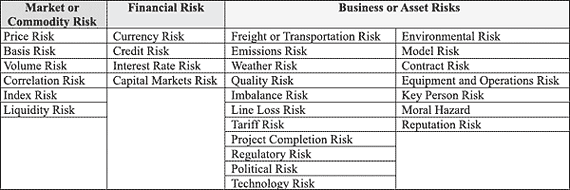
It should be noted that risk categories are never mutually exclusive. As just one example, technology risks can quickly morph into structural risks, which can just as easily become a source of credit risk.
MACROECONOMIC AND DEMAND RISK
- Dominant Impact: Commercialization and Re-commercialization
This category refers to the range of factors within the broader economy and the market segment(s) served that could affect underlying demand for the products that derive from the IP in question. It is best to address the risks in this category by first understanding the nature of the IP itself, what it does, for whom, and how. Such an analysis helps define the elasticity and scope of demand for the products derived from the IP. Topics that should be investigated include:
- What problem does this IP solve? Why does that problem exist?
- What would cause this problem to increase either in frequency or in impact?
- Is the problem systemic and pervasive (e.g. when data is transposed manually the error rate is usually 3% to 4%)?
- Or, is it specific to a certain segment of the economy (e.g. high-pressure industrial hoses have a tendency to rupture within 12 diameters of a reducer joint)?
- What types of products and market segments does this IP serve today?
- What types of products and market segments could this IP serve in future?
- What are the average price points of the products derived from this IP?
- What portion of the demand for products derived from this IP could be considered inelastic or nondiscretionary?
- What are the implications for demand for products derived from this IP if long-term interest rates rise/fall by 1%? The trade-weighted value of the dollar rises/falls by 10%? Economic growth slows/ quickens by 1%? Economic growth is negative? Real per capita incomes (in the geographies served) increases/declines by 1%? Energy prices rise/fall by 10%? 25%?
- What is the geographic breakdown of revenues associated with the products derived from this IP?
- How many licensees does this IP have? How many do you expect to have in three years? What is the financial profile of a licensee (this may also be a credit risk)?
- List the types of supply-chain disruptions that could interrupt the production of the items derived from this IP. In general, the greater the number and dispersal of manufacturing locations that can produce these types of products (and their materials and components), the lower the likelihood of a supply chain disruption.
- Do public health and safety considerations impact the sale of derived products? For example, IP related to food processing technology can be affected by health events and outbreaks that subsequently lead to embargoes on food trade.
- Does this IP affect issues of defense or national security? What is the likelihood that sales of the derived products would be restricted due to political decisions (i.e. export restrictions)?
TECHNOLOGY RISK
- Dominant Impact: Commercialization and Re-commercialization
Secondary Impact: Assertion
Technology risks refer to the broad range of competitive factors that could erode, shorten, or make more volatile the expected revenue stream or its profitability. In general, technology risks come in one of two types: superior technologies (threats you can see coming) and unrelated technologies (threats you may not have had reason to consider). Unrelated technologies usually cause more damage by way of both timing and scope. Consideration should be given to the following topics:
- How many competing technologies exist versus the IP in question? Is there a monopoly? A duopoly? What are these competing technologies?
- How long has this competitive landscape been in place? What would cause it to change? Are there recent entrants or exits?
- List the strengths and weaknesses of each of the competing technologies. Know that a major source of risk is when competitive offerings are better than, but not as cheap as, the item produced using your IP. This usually creates incentives for enabling technologies to commercialize the competing IP at lower price points.
- Under what macroeconomic conditions would a competitor’s weakness become a non-issue (list all conditions without regard for likelihood)? For example, if the price of oil climbs to 1-1/2 times its current price, certain oil exploration technologies become significantly more competitive. In general, then, it is useful to analyze and model the marginal conditions and inflection points within any competitive structure.
- Under what technological conditions would a competitor’s weakness become a non-issue (list all conditions without regard for likelihood)? For example, if the latency conditions in a memory circuit can be made to drop below a pre-defined threshold, certain possibilities emerge within memory management that can alter the competitive profile of IP dealing with firmware. In this example, one notices that competing technologies are not other pieces of software but rather an unrelated advance in semiconductor manufacturing that leads to a different way of constructing a memory circuit, which in turn can nullify one’s competitive advantage.
- What factors and/or market segments drive demand for all the products using your IP? What factors and/or market segments drive demand for all the products using competing technology or public domain methods? Are these identical factors and market segments? If not, does the competitive IP have a segment where it has an inherent advantage? If that segment were to expand rapidly would it generate enough volume to lower the costs of (and enhance the competitiveness of) the competing technology?
- Which, if any, competing technologies have a weak competitive position because they are “orphan” technologies owned by underperforming companies or residing in marginal or non-core subsidiaries of larger organizations? Would that competing technology be more valuable and more of a business threat if it changed hands? If so, describe how.
COLLATERAL RISK
- Dominant Impact: Assertion and Commercialization
Collateral risk refers to those types of situations and events that damage the asset or preclude enforcement of the rights of the owner of the asset. Collateral risk may best be understood through a familiar banking analogy: mortgage lenders lend consumers money to buy homes only after thoroughly assessing the borrower’s capacity to make regular monthly payments over a period of time. However, the value of the underlying asset (i.e. the home) is also important and remains a secondary source of repayment-- through foreclosure and subsequent resale. In order to minimize collateral risk, mortgage lenders require a home inspection, title insurance, and proof of homeowners’ insurance for at least the value of the loan.
While collateral risk can take many forms, for the purposes of technology-based IP, prior transaction experience suggests that the focus be on theft, ongoing litigation, or unclear ownership. Topics worthy of evaluation include:
- Who owns the IP and for how long have they owned it? How did they come to acquire it?
- Has the ownership ever been contested? How was that matter resolved?
- Are there any cross-licensing agreements in place related to this IP?
- Are there any contingent claims or prohibitions on this IP?
- Quantify the remaining protected and productive life of this IP.
- Does this IP currently generate revenues? Is that revenue stream available to you?
- Is this IP easily reverse-engineered?
- Are there knock-off products or processes currently in use that mimic this IP?
- What is the estimated ongoing lost (diverted) revenue attributed to “mimic” IP? Has it been growing?
- Is there any brand risk associated with the products derived from this IP? For example, if this IP is used to make certain pharmaceutical compounds (process patents) for companies that are the subject of classaction litigation (i.e. Bausch & Lomb) then revenue streams could be impacted by the damage to the end-use brand even if the IP owned had no direct contribution to the issue under litigation.
ILLIQUIDITY RISK
- Dominant Impact: Assertion, Commercialization, and Re-commercialization
IP is one of the more illiquid asset classes due to the difficulty in valuation and the risks related to the enforcement of rights. Illiquidity risk is usually measured by bidask spreads, transaction costs, and the time taken to complete a transaction. In the case of IP, however, estimating illiquidity is as much art as science and the estimate itself would likely be very different from the actual experienced illiquidity if and when the time comes to sell. However, there are several relevant factors to consider in estimating illiquidity:
- Is it a high-dollar-bundle of IP? The higher the dollar value of the IP bundle, the greater the potential liquidity, up to a point. This is because the largely fixed costs of valuation and transaction structuring and documentation can be spread over a larger transaction base and thus justify interest and investment by more parties.
- Is it hard to evaluate? The simpler the transaction, the greater the liquidity.
- Do you need specialized skills to manage the IP on an ongoing basis?
- Would a bank or senior lender finance more than half the transaction? If so, the liquidity would be enhanced.
CREDIT RISK
- Dominant Impact: Assertion and Commercialization
Credit risk refers to the probability that monies owed are not paid because the debtor is unable or unwilling to pay. The typical situation within credit risk is that the greater the exposure (i.e. the greater the monies owed) the greater the chance of default and consequently the “expected loss” increases in a non-linear fashion. In the context of financing the purchase of IP, that construct is happily limited since higher exposures usually coincide with scenarios wherein the sales of the underlying IP have been robust. While it may be relatively unlikely that a party would default on an arrangement and lose rights to the very IP that has been the source of its success, credit risks are very real in all business transactions. Important topics to consider include:
- If the contemplated transaction is anything less than an arms-length true sale, then is any portion of the revenue stream contingent on the credit standing of the owner of the IP (some business arrangements are structured in a way that specifies loss of investmentgrade credit rating as an event of default)?
- Who or what entity(ies) is(are) expected to be the source of the revenue stream? What is the breakdown in expected revenues? Are the revenues concentrated in one or two customers?
- What is the credit standing and profile of the various customers? Do they have any significant nearterm debt maturities?
- If they were to pay you a healthy royalty/license payment (i.e. if things go well) what portion of their cost structure would that outflow represent?
- Do they have a history of contesting IP payments? Under what circumstances?
- Would their credit profile be enhanced by the growth in the end-use of your IP (the answer to this question is usually “yes” but, if they purchased your IP as a partial hedge, it could be “no”)?
- How is their long-term debt rated (match the duration of their debt to the weighted average life of your IP)?
- Are they contractually bound to send you the revenue stream under all circumstances or do you have to demonstrate “performance” (howsoever defined) prior to being paid?
- Do you receive the monies directly or through an intermediary? If there is an intermediary involved (not an escrow) you will need to assess the conjoint probability of default.
Recall that unlike the ordinary case of business credit risk, there is no option of shutting off “supply” until the customer pays his invoice. To prevent the licensee from gainfully using your IP in the interim, owners will have to expend time and money and rely on legal protections that can be slow and uncertain and exacerbated, especially when outside of the United States.
STRUCTURAL RISK
Deal structuring permits modeling and sensitivity testing and so forms the basis for evaluating all risk variables and other inputs (i.e. market growth assumptions, elasticity of demand). As a result, the structure of a transaction typically reflects the combination of all risks and inputs. While a deal structure is designed to mitigate risks, it usually introduces new risks by virtue of its construction. Relevant topics of investigation include:
- Describe the form and details of the structure of cost and revenue agreements related to the IP. Translate the term sheet into diagrams that show the structural risk factors.
- Identify such items as: term of the arrangement; periodicity of payment; principal mode of the arrangement (i.e. royalty, license fee); base fees, minimum usage amounts (i.e. take or pay), and floors; units of measurement that drive the royalty or fee arrangements; geographic or market segment exclusivity and conditions under which those may be rescinded (include items such as true-up payments); re-selling agreements and prohibitions; and conditions of breach and cures.
- If the following items apply, be sure to document all details and scenarios: catch-up arrangements or use-it-or-lose-it arrangements; thresholds, step-functions, and waterfalls; swaps, spreads, collars, options, contingent options, escalators, and indices; contingent payments and receipts; pass-throughs and indirect revenue arrangements.
EFFECTIVE MONITORING OF RISK FACTORS
As the technological, legal, economic, and business environments of intellectual property are constantly changing, today’s practitioners must constantly monitor and analyze risks, their impacts, and the progress of any relevant mitigation/control efforts. Inadequate control not only impairs value, but can also trigger loss of confidence and disrupt--perhaps permanently--access to the bank financing/capital markets and/or deal flow. The following questions contain items that should be considered throughout a deal’s life cycle to ensure a focus on risk identification and management:
- Is there a regular status review and update of key risks to assure they are under control?
- Has a list of key risks been disseminated to the appropriate people within the organization?
- Is there progress in mitigating each risk as planned?
- For any risk exceeding defined trigger values, has a contingency plan been implemented? How will any contingency plans affect the transaction timeline?
- Has the transaction team been reviewing the deal for other risks that may have appeared?
- Has the process to accept additional risks from transaction team members and outside stakeholders been followed?
CONCLUSION
While each underperforming transaction does so in its own unique way, there are broad categories of ways in which transactions fail. A checklist can help identify and quantify the specific risk elements within categories so that they can be understood and priced. More importantly, a checklist can stimulate additional questions and highlight interconnections that would not be otherwise visible.
To extract the full benefit of the information obtained during the course of a deal life cycle, practitioners ought to capture the data derived through the checklist within a customizable and dynamic model that can evaluate the risk and return profile of the contemplated transaction under a wide range of scenarios. Such a model would be critical to transaction financing, pricing, and structuring as well as long-term risk management and control.
| Michael Sarlitto and Dan Roman are Managing Partners at SummitPoint Management, a national professional services firm providing a full array of M&A due diligence and transaction advisory services to a wide range of publicly traded and privately held companies. They can be reached at 312-441-1400 or www.summitpointmanagement.com. |

